Tổng quan

ETAP (Electrical Transient Analyzer Program) là một nền tảng phần mềm phân tích hệ thống điện chuyên nghiệp và toàn diện nhất hiện nay. Được phát triển bởi công ty Operation Technology, Inc. (nay thuộc Schneider Electric), ETAP được sử dụng rộng rãi trong các lĩnh vực từ thiết kế, mô phỏng đến vận hành và tối ưu hóa hệ thống điện.

Các tính năng chính của ETAP

ETAP cung cấp một bộ công cụ tích hợp cho phép kỹ sư thực hiện hầu hết các bài toán về điện trên cùng một mô hình:

  • Phân tích chế độ xác lập (Load Flow): Tính toán trào lưu công suất, sụt áp trên đường dây và tổn thất công suất.

  • Phân tích ngắn mạch (Short Circuit): Tính toán dòng ngắn mạch theo các tiêu chuẩn quốc tế như ANSI/IEEE hoặc IEC để lựa chọn thiết bị bảo vệ.

  • Phối hợp bảo vệ (Protective Device Coordination): Thiết kế và cấu hình các rơ-le bảo vệ, Aptomat (MCCB/MCB) để đảm bảo tính chọn lọc khi có sự cố.

  • Phân tích sóng hài (Harmonic Analysis): Đánh giá chất lượng điện năng và thiết kế bộ lọc sóng hài.

  • Khởi động động cơ (Motor Acceleration): Mô phỏng quá trình khởi động của các động cơ công suất lớn để kiểm tra ảnh hưởng đến lưới điện.

  • Hệ thống thời gian thực (ETAP Real-Time): Kết nối trực tiếp với hệ thống SCADA/DCS để giám sát, mô phỏng dự báo và điều khiển hệ thống điện đang vận hành.


Ứng dụng thực tế của ETAP

ETAP là tiêu chuẩn trong nhiều ngành công nghiệp đòi hỏi độ tin cậy cực cao:

  • Năng lượng: Nhà máy nhiệt điện, thủy điện, điện hạt nhân và các trạm biến áp truyền tải.

    ETAP Nuclear Generation

  • Dầu khí & Công nghiệp nặng: Các giàn khoan, nhà máy lọc dầu, nhà máy thép, xi măng.

    Fossil Generation

  • Năng lượng tái tạo: Thiết kế các trang trại điện gió, điện mặt trời và hệ thống lưu trữ năng lượng (BESS).

    Renewable Energy

  • Hệ thống điện tòa nhà (Data Centers): Đảm bảo nguồn điện liên tục cho các trung tâm dữ liệu lớn.

    Microgrid Energy Management System


Các chức năng chính của ETAP:

1. Nghiên cứu Đấu nối và Xâm nhập Năng lượng tái tạo

Khi tích hợp một nhà máy điện (Gió/Mặt trời) vào lưới điện quốc gia, các nghiên cứu này là bắt buộc để đảm bảo không gây mất ổn định cục bộ.

  • Grid Interconnection Studies (Nghiên cứu đấu nối): Đánh giá tác động của nhà máy mới lên lưới điện tại điểm đấu nối (PCC), bao gồm trào lưu công suất, ngắn mạch và ổn định động.

  • Renewable Penetration Studies: Phân tích khả năng chịu tải của lưới điện khi tỷ trọng năng lượng tái tạo tăng cao. Việc này giúp xác định ngưỡng giới hạn để tránh gây rã lưới khi thời tiết thay đổi đột ngột.

  • Design & Analyze Solar & Wind Farms: Sử dụng các công cụ như ETAP, PSS/E hoặc DigSILENT để mô phỏng đặc tính kỹ thuật của các turbine gió hoặc các mảng pin mặt trời (PV array).


2. Mô hình hóa và Tuân thủ Quy định (Compliance)

Để một nhà máy được phép phát điện, mô hình của nó phải phản ánh đúng thực tế và tuân thủ các quy định về lưới điện (Grid Codes).

  • Model Validation & Compliance Reports: So sánh kết quả mô phỏng với dữ liệu thực tế hiện trường để hiệu chỉnh mô hình. Báo cáo này chứng minh nhà máy đáp ứng các tiêu chuẩn về tần số, điện áp.

  • Dynamic Parameter Tuning: Tối ưu hóa các bộ điều khiển như bộ điều tốc (Governor), bộ điều áp (AVR) hoặc bộ điều khiển nghịch lưu (Inverter Control) để hệ thống phản ứng tốt nhất với các sự cố.

  • Generation Protection: Thiết kế hệ thống rơ-le bảo vệ cho máy phát và máy biến áp, đảm bảo tách thiết bị ra khỏi lưới nhanh chóng khi có lỗi để tránh hư hỏng.


3. Vận hành và Điều độ Hệ thống (Generation Management)

Nhóm này tập trung vào việc quản lý cách thức và thời điểm phát điện để đạt hiệu quả kinh tế cao nhất.

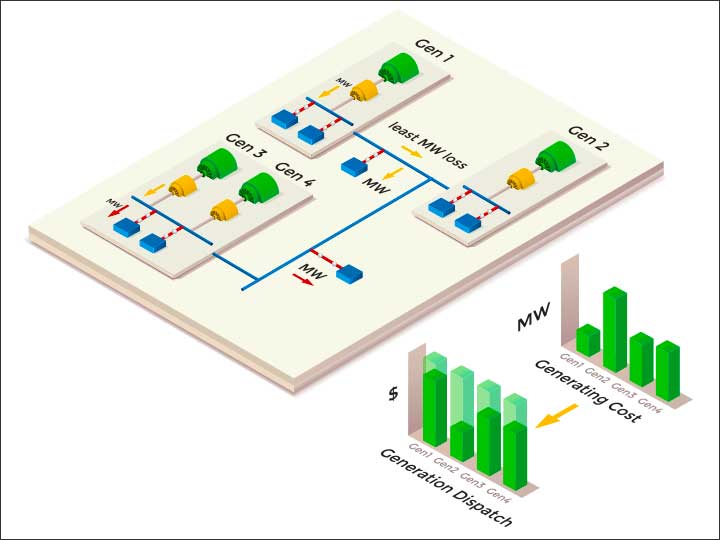
  • Unit Commitment & Dispatch (Huy động và Điều độ): Quyết định việc bật/tắt các tổ máy và phân bổ công suất phát giữa các nhà máy sao cho tổng chi phí vận hành thấp nhất mà vẫn đảm bảo dự phòng an toàn.

  • Microgrid Modeling, Design & Control: Thiết kế các lưới điện siêu nhỏ có khả năng vận hành độc lập (Island mode) hoặc kết nối với lưới điện chính.

  • Distributed Energy Resource (DER) Systems: Quản lý các nguồn năng lượng phân tán như điện mặt trời mái nhà, hệ thống lưu trữ pin (BESS) và xe điện.


4. Hệ thống Phụ trợ và An toàn

  • Power Train, Auxiliary & Safety Systems: Tập trung vào các thiết bị truyền động cơ khí, hệ thống tự dùng (bơm, quạt, chiếu sáng) và hệ thống an toàn trong nhà máy điện để đảm bảo duy trì vận hành 24/7.

  • Generation Management System (GMS): Phần mềm điều khiển trung tâm giúp giám sát và điều khiển công suất phát của toàn bộ các nhà máy trong một khu vực hoặc một tập đoàn năng lượng.

Link download phần mềm ETAP
Link download tài liệu hướng dẫn sử dụng phần mềm ETAP

Modeling & Visualization

 
Core Module - 64 Bit
• Integrated 1Ф, 2Ф, 3Ф, & DC Systems
• One-Line Graphical View - OLV
· Intelligent Electrical Diagram
· Auto-Build - Faster Layout & Design
· Templates - One-Click Modeling
· Datablocks - Info & Study Results
· Voltage Propagation & Error Checking
· Unlimited Nested Networks
· Solve Unlimited Elements & Devices
· Protective Device & Panel Systems
· Theme, Data, Configuration Managers
• 3-Dimensional Orthogonal Database
· Base & Revision Data
· Switching Configurations
· Graphical Views
• User-Access Control & Security
• Switching Device Interlock Enforcer
• Rule Books - Design Standards
• Libraries - 25+ Equipment Libraries
• Warehouse - Project Specific Library
• Study Scenario Wizards
• Power & Per Unit Calculators
• Cable Ampacity & Sizing Modules
• Cable & Line Impedance Calculation
• Schedule Reports - Cables, Transformers,
Motor Datasheets, Bus & Load Tabulation
• Multi-Language Ed. - 8+ Localized Versions

Analysis & Optimization

Network Analysis
• Load Flow & Voltage Drop
• Unbalanced Load Flow
• Unified Load Flow - AC, DC, Unbalanced
• Time Domain Load Flow
• Short Circuit - ANSI, IEC, GOST
• Motor Acceleration - Static, Dynamic
• Harmonics & Filter Sizing
• Contingency Analysis
• Reliability Assessment
• Load Allocation
• Transformer Sizing - ANSI, IEC
Network Optimization
• Optimal Power Flow
• Optimal Capacitor Placement
• Unit Transformer Tap Optimization
• Switching Optimization
DC Modeling & Analysis
• Battery Sizing
• Battery Discharge
• DC Load Flow
• DC Short Circuit

Safety & Protection

Protective Device Analysis
• Star™ - Protection & Selectivity
· Auto Evaluation - Rule-Based
· Selectivity Zone & Path Detection
• StarZ™ - T&D Protection & Selectivity
· Distance Relay - Model Specific
· R-X Characteristics Plots
· Sliding Fault & Line Loadability
· User-Editable Scheme Logic
• Device Sequence-of-Operation
• Device Library - 1000+
Arc Flash Analysis
• ArcFault™ - Arcing Fault Hazard
Evaluation up to 800 kV - NESC
• Arc Flash - IEEE 1584 & NFPA 70E
• Arc-in-a-Box - 15 to 36 kV, IEEE 1584
• DC Arc Flash - NFPA 70E, D.8.12
• Graphical Sequence-of-Operation
• Result Analyzer & Worst-Case Evaluation
• PPE Requirements Approval
• Customizable Work Permits
• Labels in Multiple Languages
System Grounding & Earthing
• Ground Grid Systems
· IEEE 80 Method
· Finite Element Method
• Protective Earthing Conductor Sizing
• Electric Shock Protection

Geospatial Diagram

• Intelligent Electrical GIS View
• Incremental Import from ESRI® GIS
• Voltage Propagation & Error Checking
• Intelligent Circuit Tracing & Loop
Detection
etapAPP™
• Data Collection & Synchronization
DataX™ - Data Exchange Interfaces
• Microsoft® Excel
• Project Merge
• Universal Mapping
• KML, OSM, CIM, MultiSpeak™
• Autodesk Revit®
• SmartPlant® Electrical
• AVEVA Electrical™
• Conversion from Legacy Software

Power Management

Model-Driven PMS
• Energy Accounting
• Event Playback
• Intelligent Monitoring
• Load Forecasting
• Predictive Simulation
• State Estimation

Energy Management

Model-Driven EMS
• Network Security Analysis
• Equipment Maintenance Scheduling
• Automatic Generation Control
• Economic Dispatch
• Unit Commitment
• Interchange Scheduling
• Reserve Management
 

Microgrid

Microgrid Management System
• Generation Optimization
• Energy Storage Management
• Generation & Load Forecasting
• Demand Side Management
• Economic Dispatch
• Supervisory Control
• Unit Commitment
• Volt/VAR Optimization - VVO
 

Automation & Control

iSub™ - Intelligent Substation
• Substation Automation
• Switching Order Management - SOM
• Switching Sequence Validation
• Load Management
• Demand Side Management
ILS™ - Intelligent Load Shedding
• Instantaneous Load Shedding
• Optimal Load Preservation
• Automated System Restoration
• Integrated Validation via Transient
Stability
• Intelligent Automatic Subsystem
Islanding
• Time-Based Load Priority Schedules
Distribution Load Shedding
• Load Curtailment Management
• Automatic & Manual Outage Rollouts
• Optimized Rolling Outages
• Priority-Based Customer Restoration
• Interruption Minimization per Customer
per Time Periods
• Under-Frequency & Overload Shedding
iCE™ - Intelligent Controller
• Remote Terminal Unit - RTU
• Programmable Logic Controller - PLC
• Data Acquisition & Control
• Secure Universal Controller
• Integrated Fault Detector
• Fault Tolerant Hardware
• Built-In Redundancy
• Communication Protocols
• Wireless Communications
 

ADMS

Distribution Management - DMS
• Network Connectivity Analysis
• Distribution State Estimation
• Load Forecasting - Short & Long-Term
• Asset Operation Monitoring
• Predictive Simulation
• Fault Detection & Identification
• Fault Location, Isolation & Service
Restoration - FLISR
• Switching Order Management - SOM
• Volt/VAR Optimization - VVO
• Feeder Balancing & Loss Minimization
• Technical & Non-Technical Energy
Losses Report
Outage Management - OMS
• Crew Dispatch & Work Management
• Outage Analytics & Reporting
• Planned Outage Management
• Storm Assessment
• Trouble Call Management
 

Video

Cấu hình

ETAP 18 Requirements

Operating System (64-bit)

Microsoft Windows® 10 (Home Premium, Professional, Enterprise)

Microsoft Windows® 8 & 8.1 (Standard, Professional)

Microsoft Windows 7 (SP1) (Home Premium, Professional, Ultimate, Enterprise)

Microsoft® Server 2016 (Standard)

Microsoft Server 2012 & 2012 R2 (Standard)

Software Prerequisites

Internet Explorer® 10 or higher (or minimum version level specified by the Operating System)

ETAP launches the following installations:

Microsoft .NET Framework v3.5 (SP1)

Microsoft .NET Framework v4.0

Microsoft .NET Framework v4.5

Microsoft .NET Framework v4.6.2

Microsoft SQL Server Compact 3.5 (SP2)

Microsoft Windows Update (KB2670838)

Microsoft SQL Server 2012 Express LocalDB (x64)

Microsoft SQL Server 2012 Native Client (x64)

Microsoft SQL Management Studio 2012 (x64)

Other Third Party Software

Microsoft SQL Management Studio 2012 (x64)

Mongo DB

DB Browser for SQLite

Python 3.5

PC Configuration Requirements

64-bit hardware

USB port for security key

Ethernet port with network access (if network licensing required)

DVD drive, 10 to 80 GB hard disk space (based on project size, number of buses)

Recommended Display

19” monitors

Dual monitors, highly recommended

Resolution - 1920 x 1080

Font scaling - 100% - 125%

Recommended Hardware

100 Bus Projects


Intel Core i5 or better – 2.4 GHz or better (or equivalent)

8 GB RAM

500 Bus Projects


Intel Core i5 or better – 3.0 GHz or better (or equivalent)

8 GB RAM

1000 Bus Projects


Intel Core i7 or better – 3.0 GHz or better

16 GB RAM (high speed)

10,000 Bus Projects and Higher


Intel Core i7 or better – 3.0 GHz or better

32 GB RAM (high speed)

Dùng thử

Vui lòng điền thông tin dưới đây để nhận bản dùng thử của chúng tôi
Họ tên
Công ty
Email
Địa chỉ
Điện thoại
Phần mềm

Báo giá

Họ tên
Công ty
Email
Địa chỉ
Điện thoại
Phần mềm
Lời nhắn